Stainless Steel Mesh Count vs Micron: Why Wire Diameter Matters
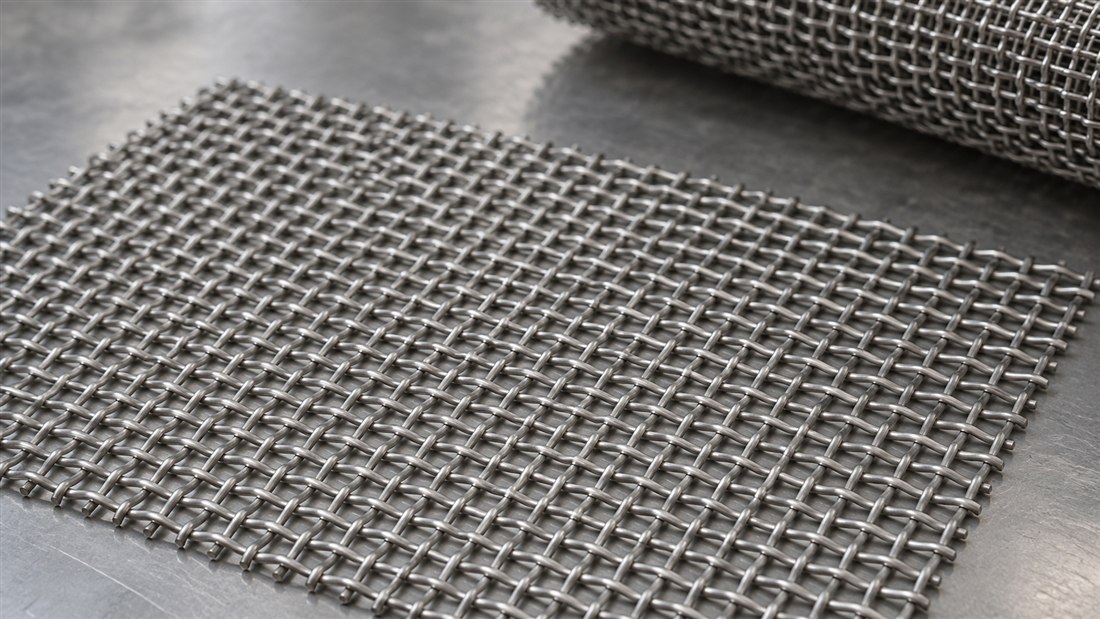
Mesh count is not a micron rating. For regular square woven stainless steel mesh, the clear opening depends on both the count and the wire diameter. Two screens sold as “20 mesh” can therefore pass different particle sizes. For Dutch weave filter cloth, a square-opening calculation does not establish the filtration rating: the weave and the stated test method must also be reviewed.
This distinction matters when replacing a production screen, comparing quotations or specifying mesh for a strainer. A matching grade and mesh count do not, by themselves, prove that the replacement will behave like the original.
What Does the Mesh Number Actually Describe?
In the per-inch convention, mesh count describes the number of repeating openings per linear inch. It is a count along one direction, not the opening area in a square inch. A square mesh has matching spacing in both directions; rectangular and filter weaves may have different warp and weft counts.
The useful terms are pitch, the distance between adjacent wire centres; wire diameter, the thickness of a wire; and aperture, the clear space between wires. An inquiry that specifies only “fine stainless steel mesh” leaves all three unresolved.
Calculate the Opening, Then Check the Tolerance
For an ideal regular square mesh with round wires, use the following nominal relationships, where N is the mesh count per inch and d is the wire diameter in millimetres:
Clear opening a = p − d
Opening in micrometres = a × 1,000
Projected open area = (a / p)² × 100%
These equations describe geometry. They do not replace measurement of the finished cloth, aperture tolerances or a filtration test. They also assume equal spacing and wire diameter in both directions.
Two 20-Mesh Screens: A Worked Comparison
Consider two hypothetical square woven screens with the same 20-mesh count. Their pitch is 1.27 mm. Changing the wire diameter changes both the opening and the proportion of the surface available for passage.
| Parameter | Example A | Example B |
|---|---|---|
| Mesh count | 20 per inch | 20 per inch |
| Wire diameter | 0.40 mm | 0.50 mm |
| Calculated opening | 0.87 mm / 870 µm | 0.77 mm / 770 µm |
| Calculated open area | 46.9% | 36.8% |
Example B has a smaller opening and less open area even though its mesh number is unchanged. A price comparison that overlooks wire diameter is therefore incomplete. Open area alone also cannot predict the operating flow rate: fluid properties, support geometry, contamination loading and pressure difference affect the installed result.
When preparing a specification, the stainless steel woven wire mesh product page provides the available weave families and supply forms to review alongside these dimensions.
Why a Micron Label Needs More Explanation
Square Opening and Filtration Rating Answer Different Questions
An aperture measurement describes an opening. A retention rating describes performance under a defined assessment. Particle shape, orientation and the test conditions matter, so an opening stated as 100 µm should not automatically be represented as a certified “100-micron absolute” filter.
For Dutch weave, wires form a denser, three-dimensional passage structure rather than the simple square opening used in the example. Ask whether the supplied figure is a calculated geometric pore size, a test-derived pore assessment or a particle-retention result. A nominal or absolute label needs a definition and supporting method before two offers can be compared.
Do Not Solve Every Process Problem with Finer Mesh
If a replacement screen blinds quickly, record what is collecting on it and where the blockage starts. If unwanted particles appear downstream, inspect the perimeter seal and physical damage as well as the cloth. Increasing fineness will not repair a bypass path around a screen. These observations help distinguish a specification mismatch from an installation or operating problem.
A Practical Replacement-Screen Check
- Identify the construction. Record square or Dutch weave, warp and weft direction, and whether the original assembly includes support layers.
- Measure the usable sample. Check count, wire diameter and openings on an undamaged area using equipment suitable for the mesh fineness. A phone photo is useful for context but is not dimensional evidence.
- Describe the operating duty. Include the material being screened, liquid or gas where relevant, temperature, cleaning method, pressure difference and the current failure symptom.
- Define acceptance. Agree tolerances, inspection locations, edge quality, permissible defects and any required filtration verification before order confirmation.
Material selection remains a separate check. The 304 wire mesh and 316L wire mesh pages are useful product starting points, but neither a grade name nor its appearance establishes suitability for an unspecified process fluid.
Questions Buyers Often Ask
Can I order from a mesh-to-micron chart?
Use a chart only when its wire diameter and weave assumptions match the intended product. A chart with mesh count alone does not define a unique opening for industrial wire cloth.
Does changing 304 to 316L make the mesh finer?
No. Fineness depends on the mesh geometry and filter structure. Grade and geometric requirements must both appear in the purchase specification.
What should accompany a request for quotation?
Send the grade, weave, count in both directions, wire diameter, aperture or defined filtration requirement, roll or cut-piece dimensions, edge requirements, quantity and destination. Include the drawing or original sample specification when replacing an existing screen. SAKYSTEEL can review the requested woven mesh supply form and inspection scope against these details.