Stainless Steel Wire Mesh Inspection: A Buyer’s Checklist
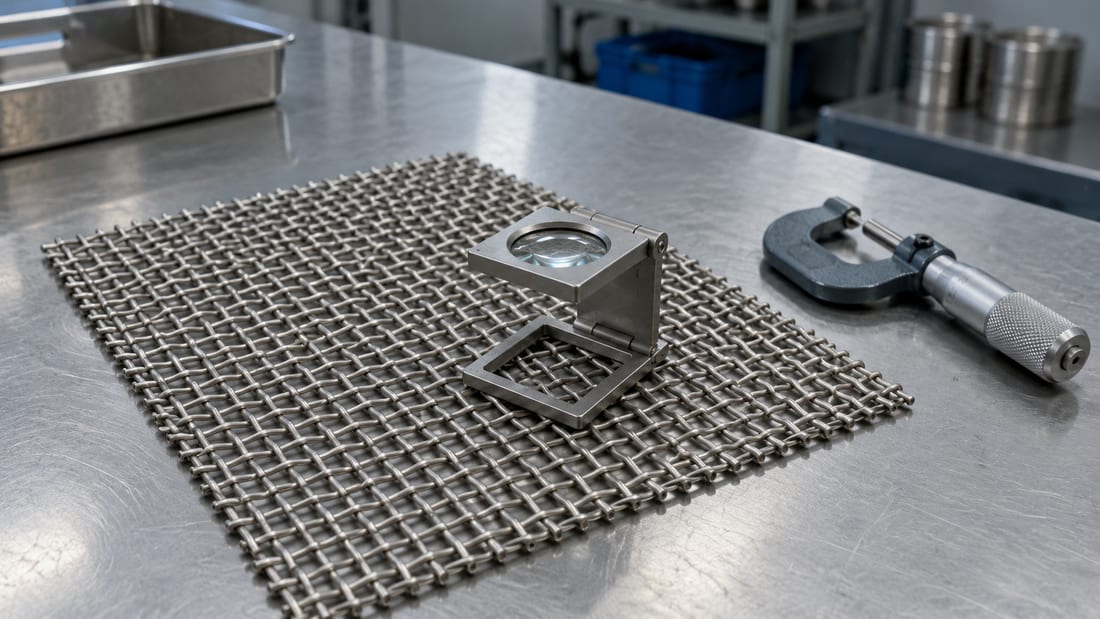
Inspect stainless steel wire mesh against the ordered construction, opening, wire diameter and agreed acceptance criteria—not its appearance or mesh count alone. For woven screening mesh, check both wire directions and look for isolated oversized openings as well as the average aperture. For Dutch weave filters, a square-opening measurement does not establish the filtration rating.
This guide focuses on incoming rolls and cut pieces before they are fabricated into screens or filters. It explains what to record, where routine checks can mislead buyers, and which questions belong in the purchase order.
Agree the Acceptance Basis Before the Mesh Arrives
A description such as “304 mesh, 100 mesh” leaves important details unresolved. The purchase specification should identify the weave, wire diameter in each direction, opening or filtration requirement, roll dimensions, edge condition and permitted defects. A tighter requirement added after delivery can turn an avoidable specification gap into a dispute.
ASTM E2016 covers industrial woven wire cloth for general use, with dimensional and delivery requirements. Its scope excludes several special constructions, including Dutch weave/filter cloth, test sieve cloth and welded wire cloth. Do not write “ASTM E2016 compliant” across every mesh order. Confirm the applicable specification and edition for the actual construction; obtain the full contractual requirements rather than deriving acceptance limits from a website summary.
Three different records: an ordered nominal dimension is a requirement; a catalogue figure describes a proposed product; an inspection result is a measurement from identified material. Keep these separate in the receiving report.
What to Check on Receipt
| Inspection item | What the receiving record should show |
|---|---|
| Identification and traceability | Purchase order, roll or piece number, grade, weave and corresponding material documentation. Keep labels with cut sections. |
| Opening and wire diameter | Specified values, actual readings, measurement direction, positions, method and instrument identification. |
| Usable dimensions | Width and length, required cut-piece dimensions, edge treatment and any damaged areas that reduce usable material. |
| Weave condition | Locations of broken or missing wires, displaced intersections, abnormal openings, creases and other visible irregularities. |
| Surface and packaging | Wet wrapping, contamination, corrosion-like marks, impact damage and photographs taken before material is cleaned or altered. |
Measure the Opening, Not Just the Mesh Count
Check both directions and more than one position
A count over a short distance can miss variation elsewhere in the roll. Follow the sampling and measurement procedure agreed for the order. Record longitudinal and transverse measurements separately, and distinguish checks near an edge from checks in the working area. Do not force the mesh flat or stretch it merely to obtain a passing reading.
For regular square woven mesh, a measuring-row method obtains average pitch from a measured length and a counted number of pitches. Subtracting the measured wire diameter gives the average clear opening. Use consistent units and the correct pitch count. The method is useful for average geometry; it does not replace a search for individual oversized openings.
Use an instrument appropriate to the opening
Coarse openings may be accessible to mechanical measurement, while fine mesh generally needs suitable optical measurement. Select resolution and method to suit the specified tolerance. Woven wires are deformed during weaving, so a measurement on finished cloth is not automatically proof of the original wire’s pre-weaving diameter tolerance. Record exactly what was measured instead of treating these as interchangeable results.
For available constructions and the relationship between opening and wire size, review our stainless steel woven wire mesh. The inspection plan should be tied to the selected specification, not to the broad product name.
Separate Local Defects from Average Results
A satisfactory average aperture does not mean every opening is suitable. A displaced wire can create a local gap while leaving an average measurement nearly unchanged. Similarly, an intact mesh pattern does not rule out a crease that prevents the material from seating correctly in a frame.
Photograph suspect areas with a scale and record their distance from an identifiable roll edge or end. Describe the condition rather than declaring every visible mark acceptable or unacceptable. The agreed specification, usable area and intended application determine disposition. A screen panel and a fine process filter may require different acceptance decisions.
Dutch weave requires a filter-specific assessment
Dense Dutch weave creates a flow path different from the visible square openings of ordinary screening mesh. Ask what a stated micron rating means, how it was determined and whether it represents nominal retention, a defined maximum passage criterion or another agreed test result. A mesh count or a photograph alone cannot establish filtration performance under the customer’s operating conditions.
Handle Nonconforming Material Without Losing the Evidence
- Identify and hold the affected material. Separate suspect rolls or pieces from released stock and retain their labels.
- Record the finding. Include the requirement, actual result, location, instrument and photographs. Note whether the finding is isolated or appears across several sampled areas.
- Check the measurement method. Resolve unit errors, direction, instrument suitability and sample condition before comparing results from different parties.
- Agree the disposition. Replacement, further inspection, sorting or limited use requires a documented decision. Do not cut away evidence or accept reduced usable area without agreement.
Questions Buyers Often Ask
Does a material certificate prove the mesh opening is correct?
No. Material chemistry documentation and dimensional inspection answer different questions. Check what the certificate actually covers and request opening, wire-diameter or filter-performance records separately where needed.
Can a supplier’s sample replace inspection of the delivered roll?
A sample can establish an agreed reference for construction or appearance. It does not, by itself, document the dimensions or condition of every delivered roll. Define how the approved sample relates to contractual acceptance and lot inspection.
Should every roll be rejected for a visible weaving mark?
Not automatically. Record and assess the mark against the applicable requirements and functional use. Conversely, an attractive surface should not override a failed aperture measurement or missing traceability.
Put the Inspection Requirements in Your Enquiry
Send SAKYSTEEL the material grade, weave, aperture or filtration target, wire diameter, roll or cut-piece dimensions, quantity and destination. Include the governing specification, acceptance criteria and any required inspection records. This allows the quotation and inspection scope to be reviewed together before an order is confirmed.
Discuss Your Mesh Specification
Technical references: ASTM E2016-22 scope; wire mesh measurement methods. The workflow above is procurement guidance, not a replacement for the agreed inspection standard.